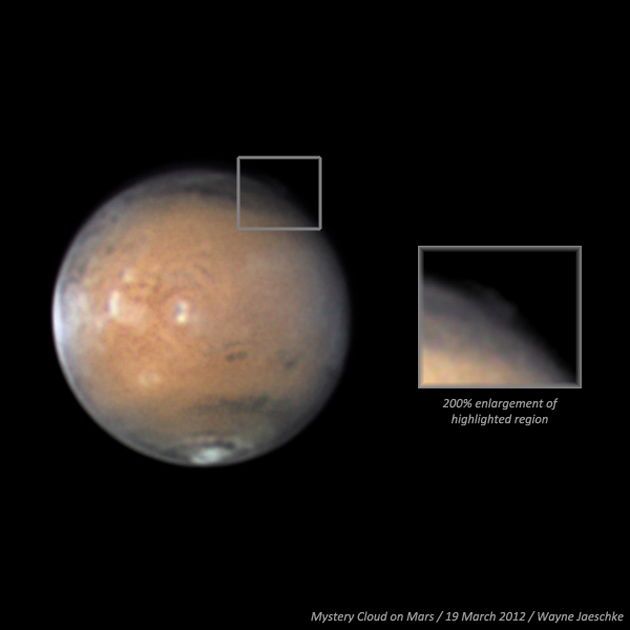
Hi! If you're new here or came here to look for information about the anomalous cloud on Mars, please read this.

May 132012
 

Mars is getting quite small and beginning to set into the west at sunset now, so not too much detail was possible last night.  The seeing was just fair and high clouds were passing through.

This view shows clouds over the morning climb extending from Eden into Chryse.

Share
May 032012
 

Better seeing this evening, just before the storm rolled in.  Here’s Mars showing Ascraeus Mons just rising and in the morning haze over Tharsis.  Chryse and Acidalia are just past the meridian.  Chasma Borealis is seen in the tiny North Polar Cap (bottom in this south-up image.)  Those who notice the clear patch in Acidalia and wonder whether that’s a dust storm (as has been asked many times this apparition), that’s Achillis Pons, an albedo features that’s evolved slightly and slowly over many years.  Also, there is some haze over the southern hemisphere over Erythraeum.

Share
May 022012
 

Clavius, Copernicus and Vallis Alpes walk into a bar…

No.  Wait.

Clavius, Copernicus and Vallis Alpes are two craters and a valley on the Moon.  Here are pictures of them to prove it (although I could be lying, you could always use Google and find out for yourself.)  Once you’re done, you can click on each of the pictures to enlarge them.

First, Clavius.

And Copernicus…

And Vallis Alpes (which I suppose is the latin equivalent of “Alpine Valley”, which makes absolutely no sense given that this is on the moon… but given how bored astronomers must get and how many thousands of craters, mountains, valleys, and other weird things there are to name in the universe, we’ll just go with it.)

Share
May 022012
 

Nope, not the BMW… the globular cluster.  I don’t know why I even bother with them when the seeing isn’t good, but I suppose since the word “globular” makes my wife giggle it’s worth the effort.

Anyway, here’s M5 taken on a night of very (very!) poor atmospheric seeing.  It doesn’t have the glitter of stardust that good seeing provides, but it still shows the density of the core and mix of new (blue) and old (orange) stars.  Click to enlarge.

Share